MING Labs is a global venture builder and corporate innovation company that partners with organizations to discover new growth opportunities through design. Operating across multiple continents, the firm specializes in taking clients from high-level goals and initial ideas to market-ready solutions and first revenue, navigating the complex terrain of stakeholder alignment, customer discovery, and rapid prototyping.
Challenge: Compressing innovation timelines while maintaining quality and alignment
When an animal feed additives producer approached MING Labs with a challenge around chicken farming, the brief was deliberately vague: How could AI help farmers and veterinarians diagnose and prevent disease spread in chicken populations? With one sick bird potentially wiping out an entire barn, the stakes were high, but the pathway to a solution was unclear.
For Sebastian Müller, founding partner of Strategy and Ventures at MING Labs, this client engagement involved familiar, but nonetheless frustrating, challenges, including:
- Stakeholders with competing priorities: Customer research revealed two distinct user groups with vastly different needs. Veterinarians wanted detailed diagnostic capabilities on desktop interfaces where they could dive deep into symptoms. Farm hands needed pictorial, extremely simple interfaces they could use in barns to quickly describe problems and receive straightforward guidance.
- Globally distributed teams: The client’s headquarters in France needed to align with regional teams in Indonesia, Singapore, and Thailand. So, when it came to customer discovery, teams would travel to Southeast Asia, gather feedback, and then return to France to iterate on design. A single iteration cycle consumed a month, and this happened on repeat.
- Lack of executive bandwidth: Delays continued even after discovery, as getting on executives’ schedules to review and approve the designs that had resulted from the month of research and iteration could take another one or two months. Indeed, the entire process from initial brief to an in-hand solution typically stretched across four to six months.
“The challenge wasn’t just technical. We needed to align stakeholders across continents, compress months-long iteration cycles, and serve two completely different user groups. Traditional processes simply wouldn’t deliver fast enough.”
Sebastian Müller, Founding Partner, Strategy and Ventures at MING Labs
Solution: Miro AI as the innovation accelerator for client delivery
MING Labs had always started projects in Miro, using it for global collaboration and stakeholder alignment. But the new AI prototyping capabilities in Miro fundamentally transformed their delivery model for this project.
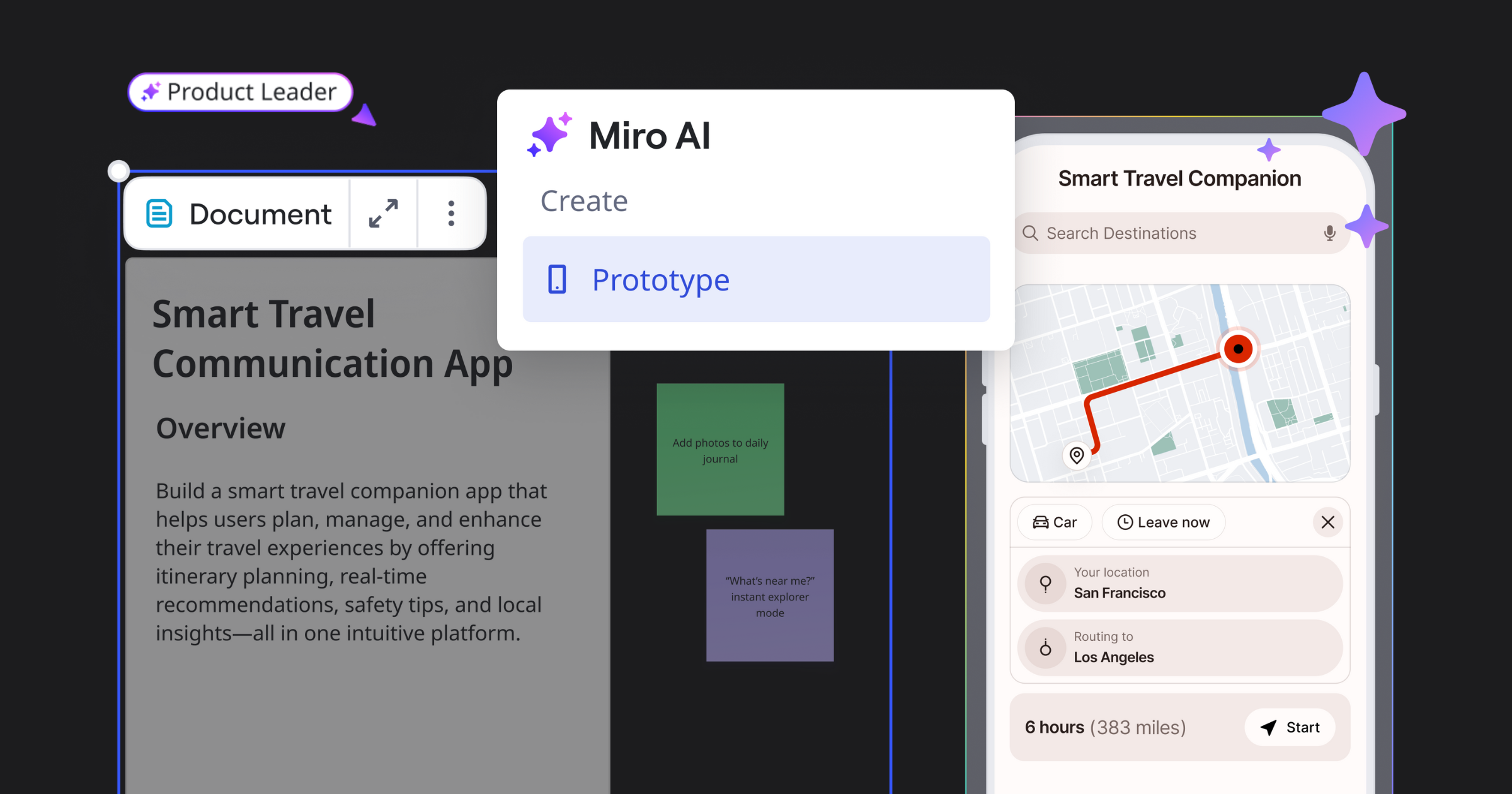
The breakthrough came in the initial definition workshop. Instead of discussing concepts abstractly with French headquarters and regional teams, then spending weeks on design iterations, MING Labs used Miro Prototypes to move from early discussions to mid-fidelity prototypes within the same session. Executives could see, interact with, and provide feedback on actual prototypes while everyone was still in the workshop. The team achieved complete alignment in hours, not months.
This compressed the early alignment phase by approximately one month — but the acceleration was just beginning.
For customer discovery, Sebastian and his team took Miro Prototypes directly into the field. In Thailand and Indonesia, they presented clickable versions to farmers and veterinarians, recorded insights directly onto the board, and then used AI to generate the next iteration within 10 minutes. What previously required returning to the office, briefing designers, waiting for iterations, and scheduling another field trip now happened onsite.
The rapid iteration revealed crucial insights. Farm hands needed pictorial, simple interfaces they could use in barns. Veterinarians required detailed diagnostic tools for desktop use. Within a month of research, MING Labs had validated two distinct product versions. Combined with using Cursor, they immediately turned mid-fidelity prototypes into working product versions.
Impact: Three months from brief to market, generating millions in incremental revenue
MING Labs delivered the complete solution in three months instead of the typical four to six months. And approximately 500 veterinarians and hundreds of farm hands were actively using it in the field within the first six months after launch. Most significantly, the AI-powered recommendations generated millions of euros in incremental sales opportunities for the client by optimizing feed recommendations based on diagnosed conditions.
The speed wasn’t just about efficiency. By compressing iteration cycles from months to weeks, MING Labs maintained momentum, kept stakeholders engaged, and validated both product versions while the project energy remained high.
The bigger picture: Custom AI sidekicks augment innovation capability
Having worked with Miro AI features for several weeks, Sebastian’s team has begun creating custom Sidekicks that augment their innovation process. “What would Steve do?” provides fresh brainstorming perspectives in the style of Steve Jobs’ “One More Thing” when ideation sessions stall. “What would Marc say?” tests whether ideas meet venture capital investment viability standards, with Marc Andreessen as its inspiration.
More strategically, MING Labs has built AI replicas of their own skill sets — business designers, service designers, UX designers, technologists. When team members are unavailable, they call on the AI to step in and provide that perspective.
“We have our own business designer, our service designer, our UX designers. Our team members are missing in action; we need that skill. We call the AI to step in, and it provides that additional perspective to round it out.”
Sebastian Müller, Founding Partner, Strategy and Ventures at MING Labs
For a consultancy where delivering client value depends on assembling the right expertise at the right moment, AI sidekicks are transforming how MING Labs orchestrates innovation — turning expertise gaps into opportunities for augmented collaboration.